
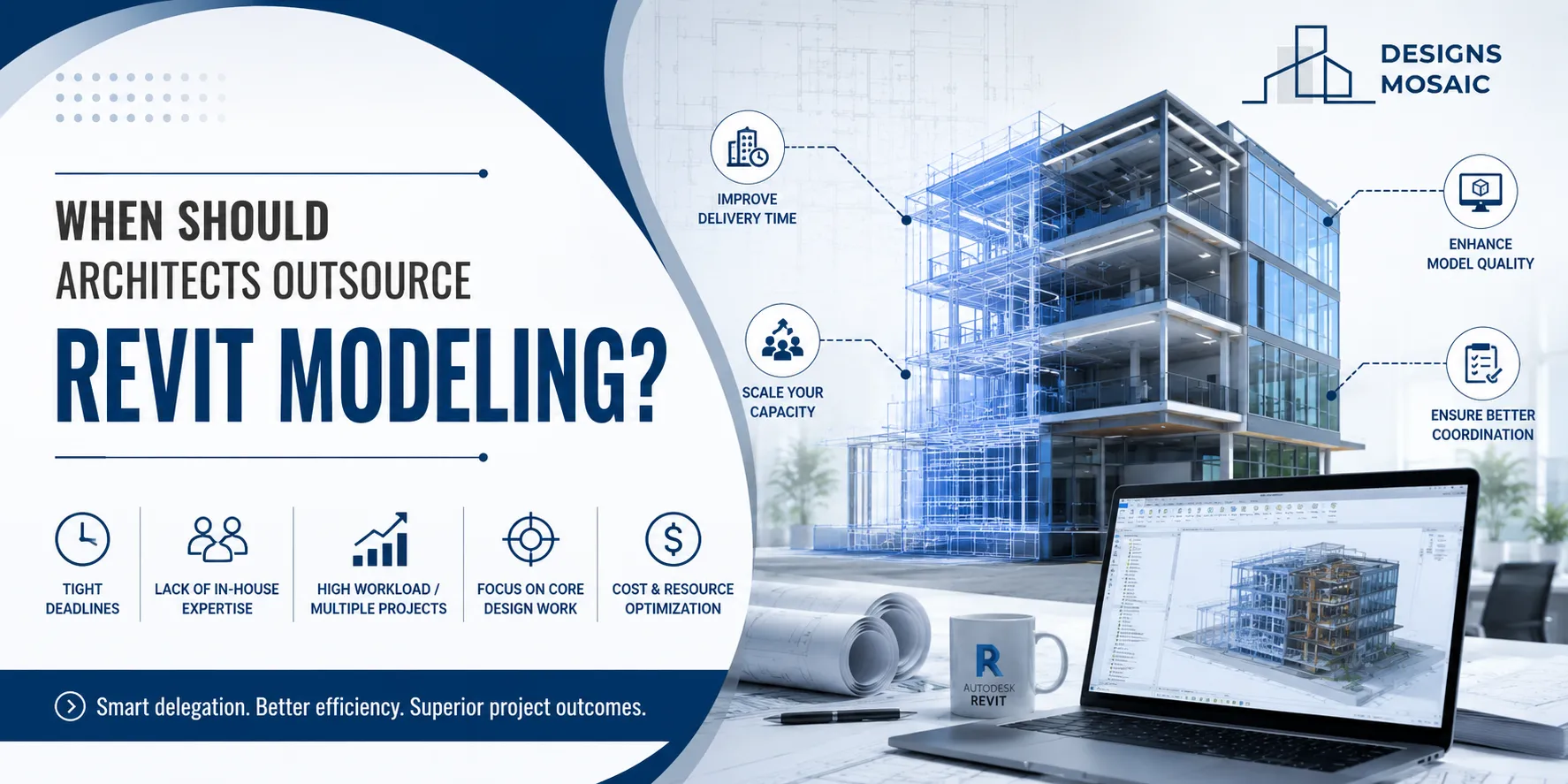
The question isn’t really about Revit. It’s about where your architects should be spending their hours.
A firm’s best design thinkers are not most valuable when they’re cleaning up family parameters or producing construction document sheets. They’re most valuable when they’re solving spatial problems, talking to clients, and making decisions that require judgment. If your senior staff is buried in production work, you have an allocation problem, not a staffing one. That’s the real context for the outsource-vs-build debate.
The Case For Building Internal Revit Capacity
Internal teams make sense under specific conditions. Not all of them.
If your firm runs a consistent, predictable workload, has project types that repeat in structure and scope, and you can justify 3 to 5 BIM staff without feast-or-famine cycles, an internal team builds something real. Institutional knowledge. Firm standards. A model environment that reflects how your practice actually works.
The other scenario where internal makes sense is when your projects are complex enough that continuous model involvement from early design through construction is genuinely necessary. Hospitals. Multi-building campuses. Projects where the BIM lead functions almost like a design team member, not a production resource.
Outside those two conditions, the math gets uncomfortable fast.
A Revit specialist in the US market runs between $65,000 and $95,000 annually before benefits, licensing, hardware, and training. Add a BIM manager for a team of three or four, and you’re approaching $300,000 in loaded cost just to maintain baseline production capacity. That number doesn’t flex when you land two projects in the same quarter and then go quiet for six weeks.
Where The Internal Model Quietly Breaks
Project Volume Doesn’t Hold Still
Architecture practices have irregular revenue cycles. A slow Q1 followed by three concurrent project starts in Q3 is not unusual. An internal team sized for peak load is expensive during slow periods. A team sized for average load is underwater when things accelerate.
This isn’t a management failure. It’s the nature of project-based work.
Specialisation Gaps Show Up At The Wrong Time
Revit is not one skill. Revit for residential documentation is a different animal than Revit for structural coordination on a mixed-use commercial build. Family creation for a curtain wall system takes a specific fluency that a generalist production team often doesn’t have. So does Scan-to-BIM. So does BIM coordination with MEP subcontractors.
When a project needs a skill your internal team doesn’t carry, you either push through with someone underqualified or scramble to hire. Neither is a good answer mid-project.
Turnover Costs More Than Firms Admit
A departing Revit specialist takes firm standards knowledge with them. Templates, family libraries, project file structures, model naming conventions built over two years. Replacing that person costs 50 to 75% of their annual salary in recruiting and ramp-up time, per most HR estimates in professional services. And the replacement is learning your environment from scratch during the projects that need them most.
What Revit Outsourcing Services Actually Solve
Revit outsourcing services are not a workaround for firms that can’t afford staff. At this point, they’re a deliberate capacity strategy for firms that are thinking clearly about where production work should live.
Here’s what outsourcing does well:
- Surge capacity without overhead: Three concurrent project starts don’t require three new hires. You scale the engagement, deliver the work, and right-size when the load normalises.
- Skill access without the retention problem: Need Revit MEP coordination for one project? Need Scan-to-BIM for a tenant improvement? Outsourcing gives you access to specialists who do those things daily, on your schedule.
- Faster mobilisation: A qualified outsourcing partner can be working in your file within days, not weeks. No onboarding, no benefits paperwork, no hardware procurement.
- Consistent output standards: Established Revit outsourcing services providers run QA processes, deliver to agreed LOD standards, and respond to coordination cycles without the management overhead of an internal hire.
What To Hand Off And What To Keep In-House
This is where firms sometimes get the balance wrong. Not everything belongs outside the firm.
Keep internally: design intent decisions, client-facing model reviews, project-specific BIM strategy, and anything requiring real-time design team collaboration at the concept stage.
Hand off externally: documentation production, shop drawing extraction, family creation, as-built modeling, CD sheet assembly, and coordination modeling that runs in parallel to design.
The boundary isn’t always clean. But the principle is: keep the work that requires your firm’s judgment and relationships. Outsource the work that requires skilled execution of defined scope.
The Hybrid Model Most Mature Firms Settle Into
The architects who have been through this cycle a few times tend to land in the same place. A small internal BIM core, one or two people who own firm standards, manage project files, and interface with external production resources. Then revit outsourcing services for production volume.
That structure works because it keeps institutional knowledge inside the firm while removing the fixed overhead of a full internal team. The internal BIM lead knows the firm’s templates, quality benchmarks, and project cadences. The outsourced team executes production scope to those standards.
It’s not a compromise. It’s actually how the work should flow if you think about it without the assumption that everything needs to happen under one roof.
A few indicators that a firm is ready for this model:
- Active project count regularly exceeds what two internal staff can document without overtime
- You’re turning down or delaying projects because of production bottlenecks
- Senior architects are spending more than 30% of their time on documentation review rather than design
- Your last two hires left within 18 months for larger firms or higher pay
Any one of these is worth taking seriously.
The Question Firms Avoid Asking
There’s a version of this conversation that gets stuck on “quality control.” The concern is real but often overstated. Firms that struggle with outsourced Revit quality almost always have the same underlying problem: they haven’t defined what good looks like clearly enough to brief an external team.
A scope of work that says “produce CDs for the attached design package” is not a brief. A proper brief specifies LOD, layer structure, sheet formatting, naming conventions, family requirements, and coordination deliverables. When those exist, quality is manageable. When they don’t, quality is unpredictable regardless of whether the team is internal or external.
The discipline of defining output standards, which outsourcing forces you to develop, tends to improve overall project quality across the board. Internal teams benefit from the same clarity. It just rarely gets documented until there’s an external handoff requiring it.
When The Answer Is Clearly “Outsource”
To make this concrete: Revit outsourcing services are the right answer when:
- Your firm is under 15 people and doesn’t have consistent enough workload to justify 3 full-time Revit specialists
- You’re entering a project type you haven’t done before and need expertise fast
- You have a documentation sprint coming and your team is already at capacity
- You want to test a new project delivery model before committing headcount to it
- Your current internal Revit staff is good but stretched thin on a specific technical scope
The answer is probably “build internal” when you have 20-plus active projects annually in the same typology, you’ve already built strong BIM standards, and you can sustain the team through slower periods without painful decisions.
Most architecture practices in the 8 to 50 person range sit somewhere between those two poles. The hybrid model is where they tend to find the most operational stability.
Conclusion
Designs Mosaic provides Revit outsourcing services across architectural documentation, structural coordination, and BIM production for architecture firms that need reliable external capacity without the overhead of building it internally. If your team is stretched on a current project or scaling into a new typology, their production team is set up to step in clean.
Frequently Asked Questions (FAQs)
1. When should an architecture firm outsource Revit modeling instead of hiring internally?
Architecture firms should outsource Revit modeling when project volume is unpredictable, when senior staff spend over 30% of their time on production tasks rather than design, or when entering new project typologies requiring specialized expertise (like Scan-to-BIM or complex MEP coordination). It is especially ideal for mid-sized firms (under 15–20 people) where maintaining 3–5 full-time BIM specialists creates unsustainable fixed overhead during quiet periods.
2. What Revit tasks should be kept in-house versus outsourced?
Firms should keep in-house tasks requiring direct design judgment and client contact, such as concept design decisions, client model reviews, project-specific BIM strategy, and real-time design collaboration. Firms should outsource execution-heavy production scope, including construction documentation (CD) sheet assembly, BIM family creation, shop drawing extraction, as-built modeling, and clash coordination.
3. What is the hybrid BIM staffing model and why is it effective?
The hybrid model pairs a small internal BIM core (1–2 specialists who manage firm standards and project quality) with an external Revit outsourcing team for scalable production capacity. This approach retains institutional knowledge inside the firm while eliminating the fixed salary, hardware, and software licensing overhead of an oversized internal team during slow quarters.
4. How do architecture firms maintain quality control with outsourced Revit services?
Quality control is maintained by providing clear, well-defined output standards before work begins. Rather than providing loose scope, firms should supply a detailed brief specifying required Level of Detail (LOD), layer structures, sheet formatting, naming conventions, family requirements, and coordination milestones. Established outsourcing providers also apply internal QA/QC reviews to ensure deliverables align with firm standards.
5. How much can an architecture firm save by outsourcing Revit modeling?
Outsourcing eliminates the fully loaded cost of full-time BIM staff, which averages $65,000 to $95,000+ per specialist annually in the US, plus benefits, hardware, training, and software licenses, along with the costly turnover risk. Instead, firms convert fixed payroll overhead into a variable, project-based cost that scales up during peak documentation sprints and scales down when project volume normalizes.