
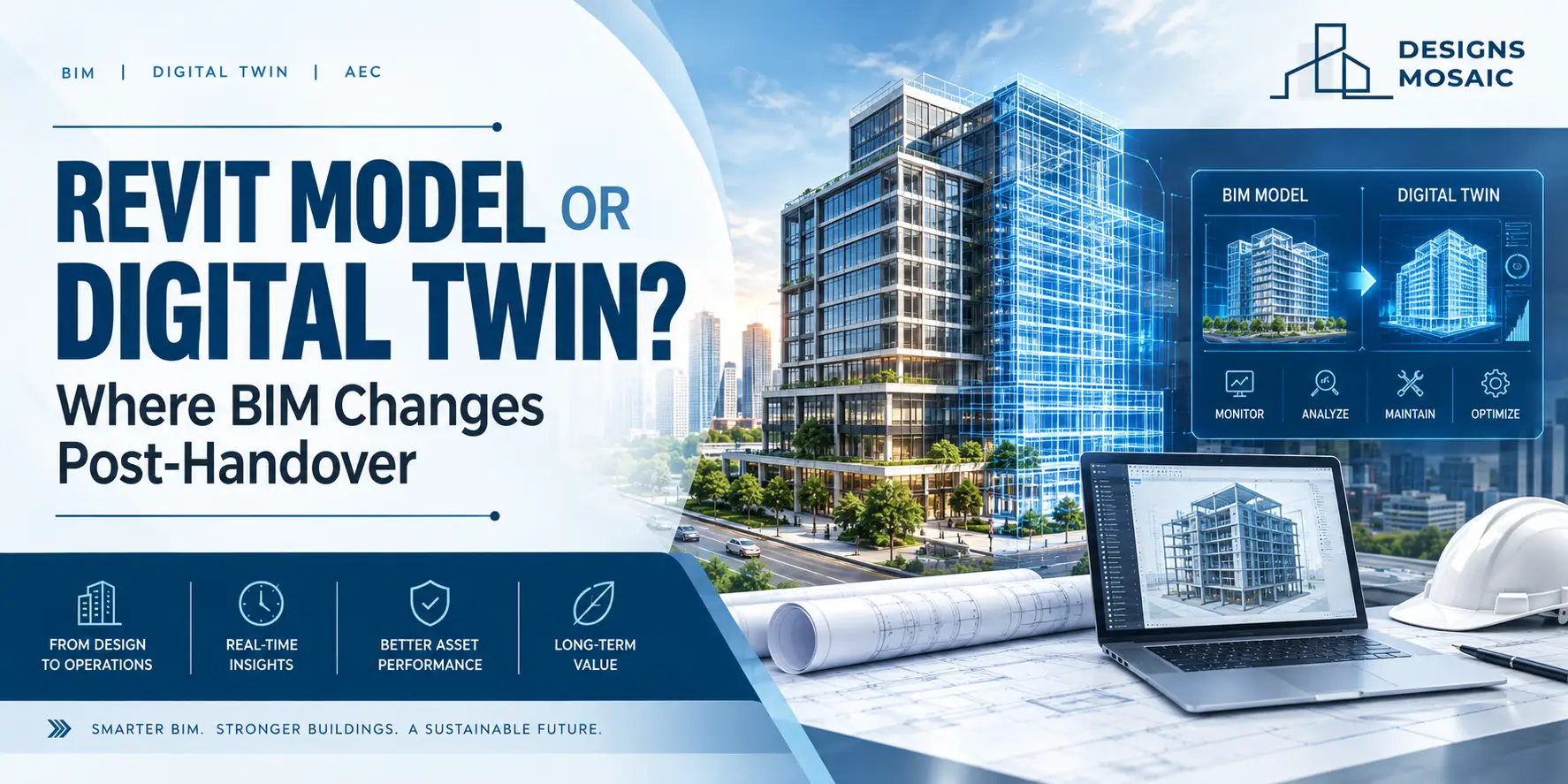
A well-developed Revit model can contain a large amount of information about a building. But once construction is complete, having a detailed model does not automatically mean the owner has a digital twin.
The difference becomes clearer at handover. Revit BIM modeling is primarily concerned with creating and managing structured building information during design, coordination and construction. A digital twin takes the concept further by connecting a digital representation with information about the physical asset during its operational life.
For AEC firms, understanding where one ends and the other begins is important.
The Revit Model Has a Defined Project Role
During design and construction, Revit can provide a shared digital environment for developing building information.
Architectural, structural and MEP teams can create discipline-specific models and use them to understand how building systems relate to one another. Models can also support drawings, schedules, coordination and clash detection.
Good Revit BIM modeling is therefore not simply about producing detailed 3D geometry. The model needs to contain information that is appropriate for its intended use.
During the project, teams may rely on it to answer questions such as:
- Where is a particular building element located?
- How does an MEP service interact with the structure?
- Are different disciplines working with coordinated information?
- What drawings or schedules can be produced from the model?
- Have approved project changes been incorporated?
The focus is largely on delivering the project correctly.
Handover changes that focus.
What Happens to BIM Information at Handover?
Once construction finishes, the building moves from delivery into operation.
The people using its information also change. Architects, engineers and contractors are no longer necessarily the primary users. Facility managers, building owners and operations teams may need information for maintenance, asset management and future changes.
This creates an important BIM challenge.
A model developed for coordination is not automatically structured for operational use. Before handover, teams need to consider which information will remain valuable after construction and whether that information accurately represents the completed asset.
This is one area where BIM consulting services can help establish project requirements and information expectations earlier in the workflow.
A Digital Twin Is More Than a Detailed Revit Model
The terms BIM model and digital twin are sometimes used as though they mean the same thing. They do not.
A Revit model generally represents building geometry and associated information. A digital twin is intended to maintain a connection between a digital representation and its physical counterpart.
Depending on the system and operational requirements, a digital twin may incorporate information from building systems, sensors, asset databases or other operational sources.
That creates a fundamental difference.
A BIM model might tell a user what equipment was modelled, where it is located and relevant information associated with it. A digital twin can potentially bring operational information into that wider digital environment.
The model becomes part of an ongoing information system rather than only a project delivery resource.
The Workflow Must Change Before Handover
Waiting until the project is complete to think about operational information is risky.
If an owner expects BIM information to support future asset operations, requirements should be considered earlier. Otherwise, the final model may contain plenty of information but not necessarily the information the operational team needs.
AEC teams should establish questions such as:
- Which assets need to be represented?
- What information needs to accompany those assets?
- Who is responsible for updating model information?
- How will construction changes be reflected before handover?
- Which information will the facility team actually use?
- Does the owner intend to connect BIM information with other systems?
These decisions influence Revit BIM modeling long before the final handover takes place.
Not Every Building Needs a Digital Twin
There is another misconception worth addressing. Moving from BIM to a digital twin should not be treated as an automatic technology upgrade.
A digital twin needs a defined operational purpose.
If the owner only needs reliable drawings and structured asset information for future reference, an appropriately prepared BIM model may be enough. Building a more complex digital environment without a clear use case can introduce additional technology and information-management requirements without delivering proportional value.
This is why BIM consulting services should focus first on what information needs to be achieved.
The question should not be, “Can we create a digital twin?”
It should be, “What decisions will this information help the owner make?”
BIM Handover Is Really an Information Handover
The most useful way to look at handover is not as the delivery of a model file. It is the transfer of usable project information from the construction team to the people responsible for the asset afterwards.
That requires accuracy, structure and clarity.
For firms planning long-term BIM use, Designs Mosaic provides BIM consulting services and BIM support including modelling, coordination and model auditing. Its BIM capabilities can support project teams in developing structured digital deliverables around defined project requirements.
FAQs
1. Is a Revit model the same as a digital twin?
No. A Revit model contains structured geometry and building information, while a digital twin is intended to maintain a broader connection between a digital representation and the operating physical asset.
2. Can an existing BIM model become part of a digital twin?
Potentially, yes. A BIM model can provide an important information foundation, but additional operational data, systems and processes may be required depending on the intended digital twin use.
3. When should digital twin requirements be considered?
Ideally, operational information requirements should be considered before handover and preferably much earlier in project planning. This allows teams to structure BIM information around its future use.
4. Does every construction project require a digital twin?
No. The decision should depend on the owner’s operational objectives and information requirements. A properly prepared BIM model may be sufficient for some projects.
5. Why is BIM model auditing important before handover?
Model auditing can help identify information quality, consistency and model-structure issues before project information is transferred to the owner or operational team.