
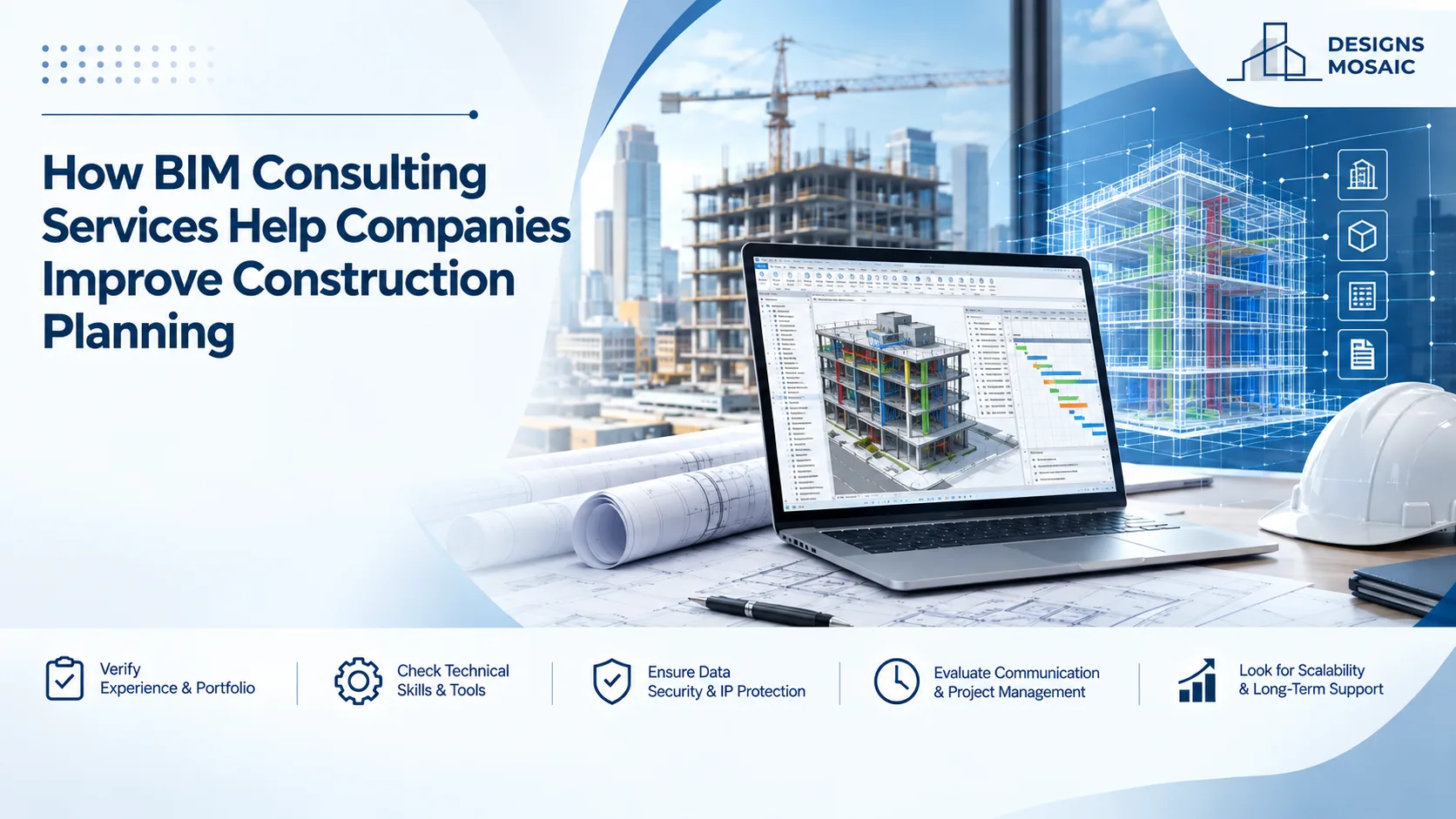
A construction plan can look complete on paper and still contain problems that only become obvious when different disciplines are viewed together.
The architectural layout may work. The structural design may work. The MEP systems may also work independently. But what happens when a duct crosses a beam, a service opening conflicts with a structural element, or teams are working from different revisions?
These are planning problems as much as design problems. BIM consulting services help project teams bring information together earlier, identify coordination issues, and create a clearer picture of what needs to happen before construction progresses on site.
Good Construction Planning Starts Before the Site Gets Busy
Construction planning is sometimes associated mainly with schedules, labour, materials, and equipment. Those factors matter, but teams also need reliable design information.
If drawings and models are not coordinated, even a carefully prepared construction programme can be disrupted.
Teams may have to stop and clarify drawings, resolve clashes, request revisions, or determine which information is current.
BIM consulting helps create a more coordinated digital foundation for those decisions.
The aim is straightforward: find and understand as many foreseeable issues as possible before they become more expensive to resolve during construction.
BIM Gives Teams a More Complete View of the Project
On a complex project, no single drawing tells the entire story.
Architectural, structural, mechanical, electrical, and plumbing information may be produced separately. Project teams then have to understand how these systems fit together.
BIM brings this information into a model-based coordination environment.
With appropriate BIM consulting services, companies can use coordinated models to examine relationships between disciplines rather than relying only on separate sets of drawings.
For a project team, that can make it easier to answer practical questions:
- Does the proposed service route conflict with the structure?
- Are openings located where the engineering teams expect them?
- Is there enough space for major building systems?
- Do different discipline models align correctly?
- Has a design revision created a new coordination issue?
Finding the answers earlier gives teams more time to respond.
Clash Detection Turns Coordination Into a Visible Process
Clashes are among the clearest examples of why BIM matters to construction planning.
Suppose an MEP model places a large duct through an area occupied by a structural beam. Each discipline may have developed its information correctly based on its own requirements, but together the two systems cannot be built as modelled.
Clash detection can flag this conflict digitally.
The relevant teams can then review the issue, understand its cause, decide what should change, and update the project information.
This does not mean every detected clash represents a serious construction problem. BIM professionals still need to review and prioritise the results. The value comes from making potential conflicts visible while teams still have options for resolving them.
Better Models Can Support Better Planning Conversations
One overlooked benefit of BIM is communication.
Construction discussions often involve people with very different technical backgrounds. A structural engineer may interpret a 2D section immediately, while another project stakeholder may need more context.
A coordinated model provides a shared visual reference.
Instead of discussing a problem only through drawing numbers and annotations, teams can review the affected area together. This can make coordination meetings more focused and help stakeholders understand why a particular change is required.
Effective BIM consulting services therefore support more than modelling. They can improve how project information is reviewed and discussed.
BIM Can Help Teams Manage Change More Clearly
Construction projects change. The challenge is keeping those changes under control.
When revisions occur across multiple disciplines, teams need to understand not only what changed but also what else the change affects.
A modified architectural layout, for example, may require structural or MEP information to be reviewed again.
A coordinated BIM process provides an environment where revised models can be checked against other project information. This gives teams an opportunity to identify new conflicts created by design development.
The benefit is not that BIM prevents change. It helps teams manage the consequences of change more systematically.
What Should Companies Expect From a BIM Consultant?
Software knowledge alone is not enough.
A useful BIM consultant should understand how models contribute to actual project delivery. That includes the relationship between modelling, drawings, coordination, revisions, and different engineering disciplines.
Depending on project requirements, BIM support may involve:
- Multidisciplinary coordination
- Clash detection
- Model auditing
- Drawing extraction
- Revit family creation
- Model updates and documentation support
The exact scope should always be established around the project’s requirements rather than applying the same BIM process to every job.
Bringing BIM Into the Planning Process With Designs Mosaic
Designs Mosaic provides BIM capabilities alongside architectural and structural engineering expertise. This multidisciplinary background allows our team to approach BIM as part of the wider design and coordination process rather than simply as a modelling exercise.
Our BIM consulting services can support modelling, BIM coordination, clash detection, model auditing, Revit family creation, shop drawing extraction, and other BIM requirements based on the defined project scope.
For companies looking to strengthen construction planning through better coordinated project information, Designs Mosaic can support the BIM process from model development through coordination and documentation.
Frequently Asked Questions
1. What do BIM consultants do?
BIM consultants support model development, coordination, model reviews, clash detection, documentation, and other BIM requirements depending on the project scope.
2. How does BIM improve construction planning?
BIM helps teams review multiple disciplines together, identify potential conflicts, understand spatial relationships, and work with more coordinated project information.
3. Can BIM eliminate construction clashes?
No. BIM can help identify many potential clashes earlier, but effective resolution still requires technical review and coordination between the relevant project teams.
4. When should BIM coordination begin?
Ideally, coordination should begin early enough for identified issues to be addressed before they affect construction activities or become costly to change.
5. Is BIM useful only for large construction projects?
No. BIM can benefit projects of different sizes, but its value depends on factors such as complexity, coordination requirements, disciplines involved, and required deliverables.