
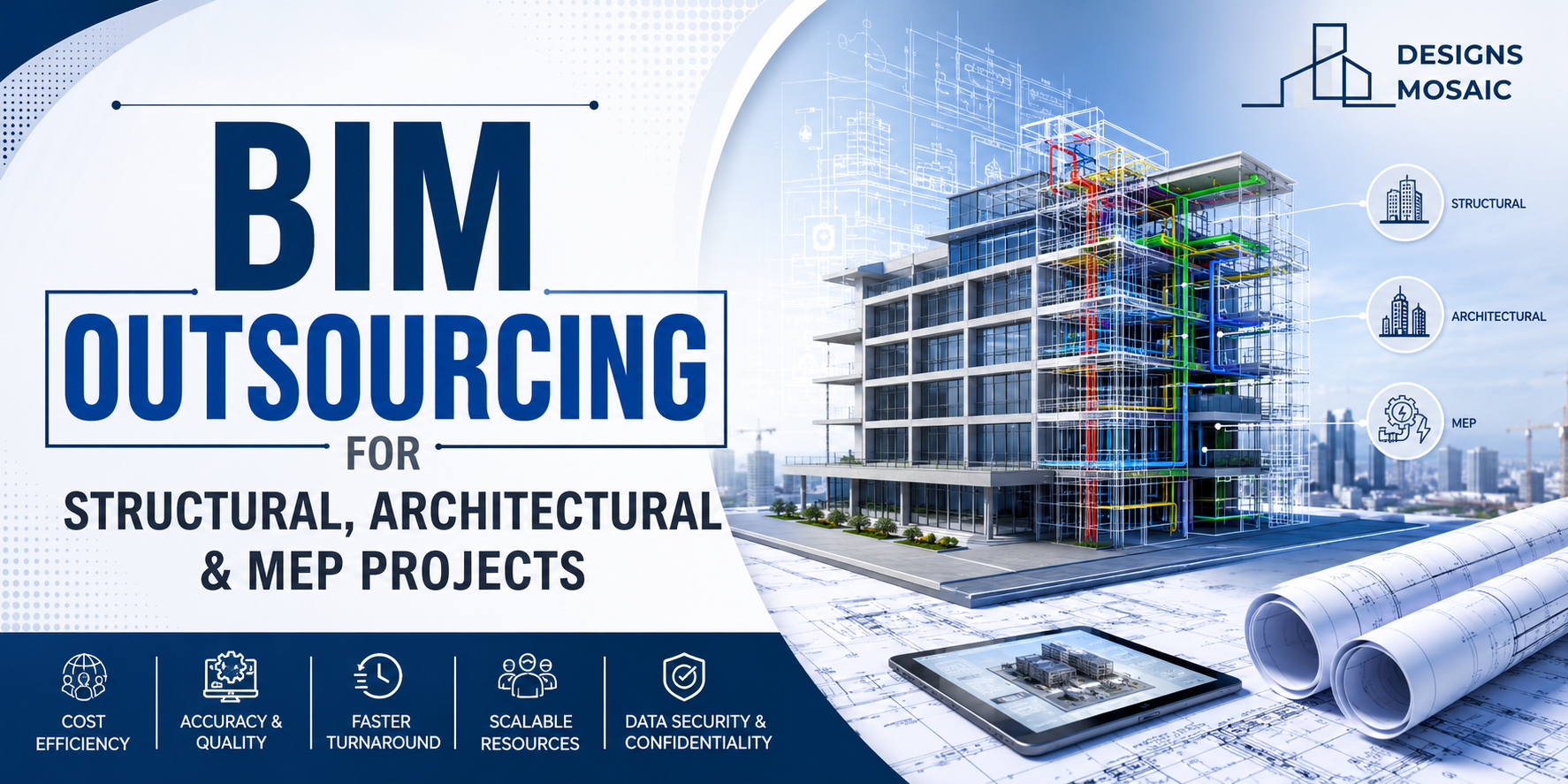
Every construction project generates an enormous amount of information long before the first foundation is poured. Architectural layouts, structural calculations, MEP coordination, design revisions and construction documentation all need to work together without conflict. When these disciplines operate in isolation, delays, rework and unexpected costs often follow.
This is where BIM outsourcing services have become an essential part of modern project delivery. Rather than treating design disciplines as separate processes, Building Information Modelling (BIM) creates a coordinated digital environment where architects, structural engineers and MEP professionals collaborate using accurate, data-rich models.
But what exactly is included when organisations choose BIM outsourcing? Understanding the scope of these services helps developers, architects, consultants and contractors make more informed project decisions.
BIM Is More Than Just 3D Modelling
One of the biggest misconceptions is that BIM simply produces attractive three-dimensional models.
In reality, BIM is a collaborative workflow that supports planning, coordination, documentation and construction throughout the project lifecycle. Every element within a model carries information that assists with design development, engineering accuracy and construction planning.
For businesses using BIM outsourcing services, the objective is not just creating models—it is improving project coordination from concept through completion.
Architectural BIM Services
Architectural models establish the foundation upon which every other discipline builds.
These models accurately represent building layouts, external elevations, internal spaces and design intent while providing a coordinated framework for consultants working on the project.
Typical architectural BIM deliverables include:
- Floor plans and elevations
- Sections and detailed drawings
- Construction documentation
- Design development support
- Model updates throughout project revisions
A well-developed architectural model helps minimise misunderstandings before construction begins.
Structural BIM Services
Structural engineering introduces another layer of complexity. Every beam, slab, column and foundation must integrate with the architectural design while satisfying engineering requirements.
Structural BIM models provide engineers and construction teams with coordinated information that improves both design quality and constructability.
Common structural BIM services include:
- Structural modelling
- Reinforcement detailing
- Steel detailing
- Foundation modelling
- Shop drawings
- Structural documentation
By incorporating structural information within the shared BIM environment, project teams gain better visibility into how different systems interact.
MEP BIM Coordination
Mechanical, electrical and plumbing systems are often responsible for many of the conflicts identified during construction.
Without proper coordination, ductwork may interfere with structural members, pipework can clash with ceilings, and electrical routes may require costly modifications on site.
Using BIM outsourcing services allows these systems to be coordinated digitally before construction starts.
Typical MEP BIM support may include:
- Mechanical system modelling
- Electrical layouts
- Plumbing system modelling
- Equipment placement
- Service coordination
- Clash detection support
Resolving these issues within the digital model is significantly more efficient than making changes during construction.
Clash Detection and Coordination
One of BIM’s greatest strengths lies in identifying design conflicts before they become site problems.
Instead of each consultant working independently, BIM enables coordinated model reviews where potential clashes between architecture, structure and building services can be identified early.
This proactive coordination supports:
- Fewer construction delays
- Reduced rework
- Improved communication between disciplines
- Greater confidence before issuing construction documents
Early coordination often results in smoother project execution and more predictable outcomes.
Construction Documentation
A coordinated BIM model also supports the preparation of detailed construction documentation.
Because drawings are generated from an integrated model, revisions can be managed more consistently across different disciplines, reducing the likelihood of conflicting information reaching the site.
Documentation commonly produced through BIM workflows includes:
- General arrangement drawings
- Sections and elevations
- Detailed construction drawings
- Shop drawings
- Coordination drawings
- Quantity-related information where required
Maintaining consistency across documentation becomes increasingly valuable as projects grow in complexity.
Scalability for Different Project Types
Construction firms rarely undertake identical projects throughout the year.
Some projects involve residential developments, while others may include commercial buildings, industrial facilities or public infrastructure. Each requires varying levels of modelling, coordination and engineering input.
By adopting BIM outsourcing services, organisations can access project-specific expertise without continually expanding internal modelling teams.
This flexibility allows businesses to manage changing workloads while maintaining consistent quality across projects.
What Should You Expect from a BIM Partner?
Selecting the right BIM partner goes beyond software capability.
A dependable outsourcing team should understand engineering workflows, communicate effectively across disciplines and deliver coordinated information that supports real-world construction outcomes.
When evaluating a BIM provider, look for:
- Experience across architectural, structural and MEP disciplines
- Consistent quality control processes
- Clear communication throughout project stages
- Ability to adapt to changing project requirements
- Reliable delivery of coordinated models and documentation
Successful BIM collaboration depends as much on process and coordination as it does on technical modelling skills.
Conclusion
As construction projects become more technically demanding, coordinated digital workflows are no longer a luxury, they are becoming an industry expectation. Comprehensive BIM outsourcing services provide the expertise, flexibility and coordination needed to support more efficient design development and better-informed construction decisions.
At Designs Mosaic, we work alongside project teams by providing BIM support across architectural, structural and MEP disciplines. Our focus is on delivering coordinated models and documentation that help projects progress with greater clarity and confidence.
FAQs
- What are BIM outsourcing services?
BIM outsourcing services involve delegating BIM modelling, coordination and documentation tasks to specialised professionals who support architectural, structural and MEP projects throughout the design and construction process.
- What services are typically included in BIM outsourcing?
They may include architectural BIM modelling, structural modelling, MEP modelling, clash detection, coordination reviews, shop drawings, construction documentation and model updates.
- How do BIM outsourcing services benefit construction projects?
They improve coordination between disciplines, reduce design conflicts, streamline documentation, enhance project efficiency and help minimise costly rework during construction.
- Which industries can benefit from BIM outsourcing services?
Developers, architects, structural engineers, contractors, infrastructure firms and MEP consultants can all benefit from BIM outsourcing across residential, commercial, industrial and infrastructure projects.
- What should you consider when choosing a BIM outsourcing partner?
Look for experience across multiple disciplines, strong quality control processes, effective communication, scalable project support and the ability to deliver coordinated BIM models and accurate construction documentation.