
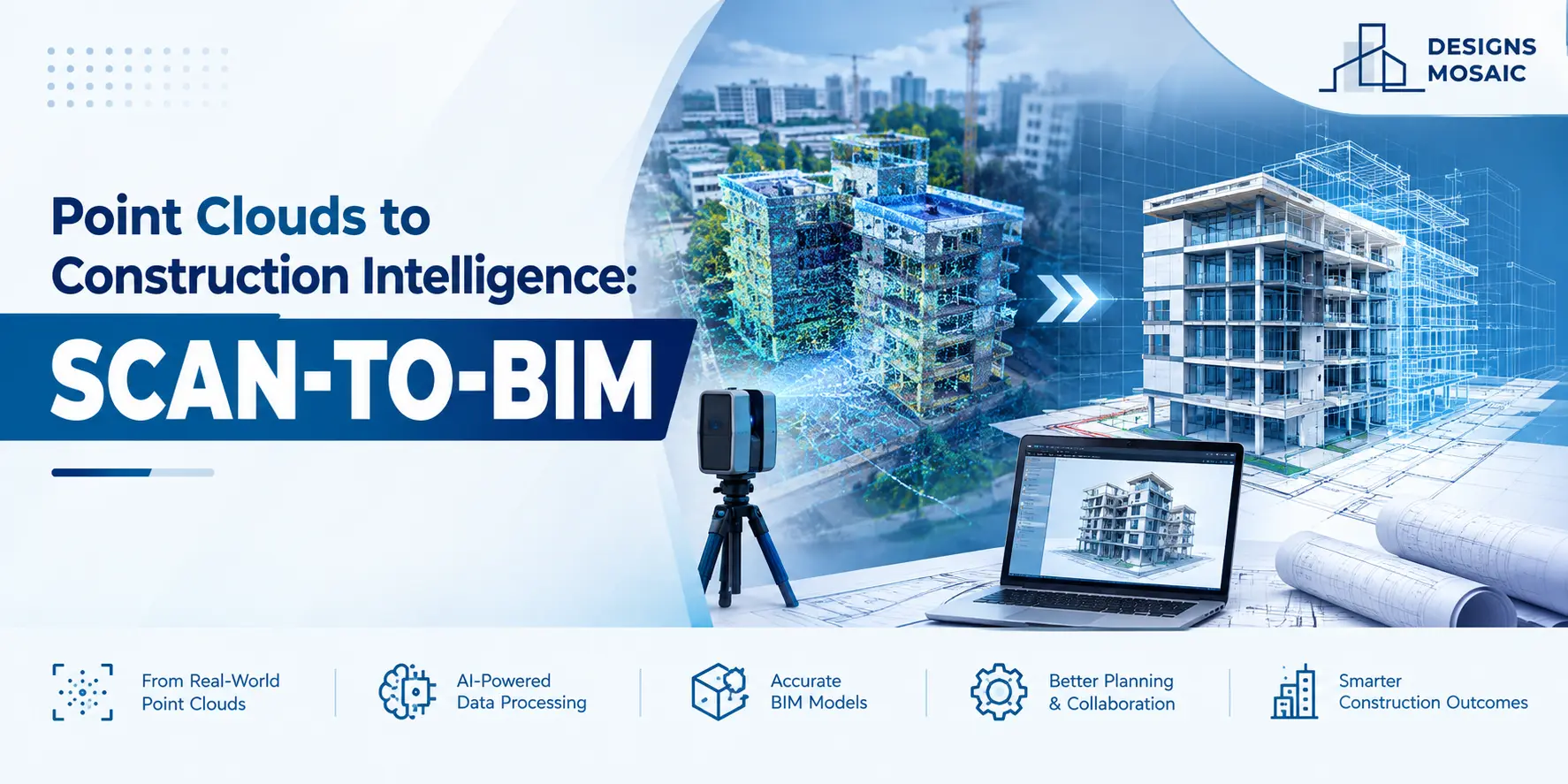
A laser scan can capture millions of points from an existing building, but collecting that data is only the beginning. Contractors, architects and engineers need to turn it into information they can understand and use.
That is the purpose of Scan-to-BIM. Point cloud data is interpreted and converted into structured building models that can support renovation, coordination, documentation and other project requirements. As AI enters this workflow, BIM modeling services are becoming less dependent on purely manual interpretation.
But AI does not make Scan-to-BIM automatic. It changes where time is spent and where professional judgement becomes most important.
The Difficult Part Begins After the Scan
A point cloud is essentially a digital record of captured spatial conditions. It can provide detailed information about the visible geometry of an existing site, but the raw data does not necessarily tell a project team what every object represents.
Someone still needs to interpret the information.
A modeller may need to distinguish between walls, structural members, pipes, ducts, equipment and other building elements. The required components then need to be represented appropriately within the BIM environment.
Traditional Scan-to-BIM workflows can involve substantial manual work, especially on large or complex existing buildings.
AI is beginning to change at this stage.
AI Can Help Turn Raw Geometry Into Recognisable Elements
One of AI’s most relevant applications in Scan-to-BIM is assisting with the recognition and classification of objects within captured data.
Instead of requiring a modeller to interpret every visible condition from scratch, AI-assisted tools can help identify patterns and potential building elements.
This can support activities such as:
- Recognising common geometric forms
- Assisting with object classification
- Separating relevant features from surrounding scan data
- Supporting repetitive modelling processes
- Highlighting areas that may require closer review
The benefit is not simply faster modelling. It is the ability to reduce some of the repetitive interpretation work involved in converting large datasets into usable models.
For providers of BIM modeling services, this creates an opportunity to direct more effort towards verification and project-specific decisions.
Recognition Is Not the Same as Understanding
This is where expectations around AI need to remain realistic.
A system may recognise geometry that resembles a wall, pipe or column. That does not mean it understands the design intent, condition or importance of that element.
Existing buildings are rarely perfect.
Walls may be slightly out of alignment. Services may have been modified over time. Equipment may be partially hidden. Scans can contain obstructions, incomplete coverage or environmental noise.
If an automated process interprets these conditions incorrectly, the resulting BIM model can look convincing while containing inaccurate assumptions.
Human review therefore becomes more important, not less.
Accuracy Should Be Defined by the Project Need
Another challenge in Scan-to-BIM is deciding how much detail should actually be modelled.
Not every visible object needs to become a BIM element.
A model being created for an architectural refurbishment may require different information from one intended for MEP coordination or infrastructure planning. Modelling everything simply because the point cloud contains it can increase file complexity and production effort without improving the project outcome.
Before starting Scan-to-BIM, teams should define:
- Which disciplines need to be modelled
- What elements are relevant to the project
- What model accuracy is required
- What level of development is expected
- Which existing conditions require detailed representation
- How the finished model will be used
This gives BIM modeling services a clear technical purpose rather than turning the process into unrestricted digital reconstruction.
From Digital Capture to Construction Intelligence
The biggest change AI can bring to Scan-to-BIM is not the elimination of modelling work. It is the possibility of moving teams faster from data capture towards useful project information.
Consider a renovation project.
The point cloud records the existing environment. The BIM model converts relevant conditions into structured elements. Architects and engineers can then work with that information while developing proposed changes. Different disciplines can review the existing conditions against new design requirements.
At this point, the value no longer comes from the scan itself.
It comes from what project teams can do with the interpreted information.
That is what turns digital capture into construction intelligence.
Where Skilled BIM Professionals Still Matter
AI can become increasingly capable at recognising patterns and assisting with repetitive processes. The difficult decisions, however, are often project-specific.
Professionals still need to determine whether captured conditions have been represented correctly, what information belongs in the model and whether the finished deliverable satisfies its intended purpose.
They also need to recognise when scan information is unclear instead of allowing software to fill gaps with assumptions.
The future Scan-to-BIM workflow is therefore likely to combine three strengths: accurate reality capture, AI-assisted processing and experienced BIM review.
Better Automation Still Needs Better BIM Decisions
AI can make Scan-to-BIM more efficient, but useful models still depend on clear requirements, appropriate modelling and technical verification.
Designs Mosaic provides Scan-to-BIM and BIM modeling services as part of its wider BIM capabilities. The team can support AEC projects in converting captured existing conditions into structured BIM deliverables based on defined project requirements.
FAQs
1. What is Scan-to-BIM?
Scan-to-BIM is the process of using captured point cloud or reality data as a reference for creating a structured BIM model of existing conditions.
2. How can AI improve Scan-to-BIM workflows?
AI can assist with recognising geometric patterns, classifying potential building elements and reducing repetitive interpretation tasks during model development.
3. Can AI automatically create a completely accurate BIM model from a point cloud?
Not reliably in every project condition. Existing buildings can contain irregular geometry, hidden elements, incomplete scan coverage and other complexities that require professional interpretation and verification.
4. Why should the required model detail be defined before Scan-to-BIM begins?
Different projects require different information. Defining model purpose, disciplines, accuracy and required development helps avoid unnecessary modelling and keeps the deliverable relevant.
5. What can Scan-to-BIM models be used for?
Depending on project requirements, they can support renovation and retrofit planning, design development, multidisciplinary coordination, documentation and understanding of existing building conditions.