
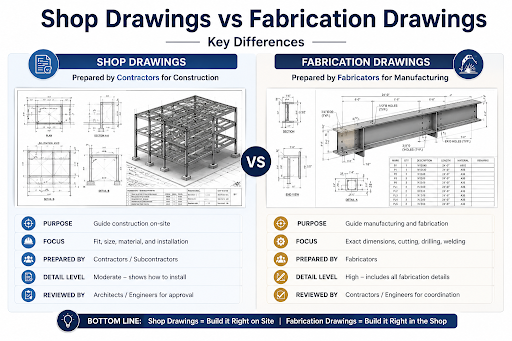
Accuracy is key in the field of construction and engineering. In order for the beams, columns, joints, and other parts to be accurately designed, a lot of planning must be done before these structures get their physical form. That is why technical drawings are indispensable tools in construction projects. Two of the most common technical drawings include the shop drawings and the fabrication drawings; both terms, which can be used interchangeably, actually refer to different drawings.
Understanding Shop Drawings
Shop drawings are highly detailed drawings made by the contractor, sub-contractor, or supplier. They are a precise depiction of how certain parts of the construction work will be put into place on-site. Shop drawings are generally created following the design process but before the start of fabrication.
While architectural or engineering general designs deal with planning, shop drawings involve practical considerations. They consider actual dimensions, materials, and installation procedures that match the site conditions.
What Shop Drawings Usually Include:
- Detailed dimensions and measurements
- Material specifications
- Installations guidelines
- Connecting joints information
- Coordinating the parts with other systems in the building
Shop drawings serve as a medium between the design conception and the construction process itself. This ensures that engineers, contractors, and fabricators have a common understanding of the project before proceeding.
What Are Fabrication Drawings?
While shop drawings are important, fabrication drawings take things up a notch. In contrast to shop drawings, which are general-purpose drawings, fabrication drawings are highly specialized technical drawings used for manufacturing purposes. Such drawings are used to give clear-cut instructions to fabricators about how they should cut, weld, assemble, and finish materials.
Unlike shop drawings, fabrication drawings allow no room for any ambiguity whatsoever. The reason is that fabrication drawings aim to create precision-manufactured components that fit together seamlessly once they are taken to the job site.
Key Elements in Fabrication Drawings:
- Cutting dimensions
- Welding instructions and symbols
- Material specifications and finishing
- Instructions for assembling
- Tolerances and quality specifications
They are very important for industries such as the structural steel industry, where the slightest error could cause serious structural problems.
Core Differences Between Shop Drawings and Fabrication Drawings
Although both types of drawings are equally important, there are some key differences that should be noted in order to avoid any misunderstandings in the process of executing the project.
1. Purpose and Function
- Shop drawings are concerned with how different elements will be assembled or fitted into the larger whole.
- Fabrication drawings are concerned with the process of how the particular elements will be manufactured.
2. Level of Detail
- The shop drawings contain enough detailing for installing the elements.
- The fabrication drawings contain extremely detailed drawings that leave no room for misunderstanding.
3. Target Audience
- Shop drawings are used by contractors, construction managers, and field engineers.
- Fabrication drawings are intended for use by fabricators and workshop workers.
4. Stage of Use
- Shop drawings are prepared before fabrication takes place and must be approved by engineers and architects.
- Fabrication drawings are prepared only after shop drawings are approved.
5. Flexibility
- The shop drawings might still incorporate some leeway in design.
- The fabrication drawings are rigid and cannot incorporate any changes to the design once the drawings have been prepared.
Why Both Drawings Are Essential in Steel Projects
Shop drawings and fabrication drawings complement each other in steel structures. They are two different drawings, and neither of them can be used in place of the other. This is because shop drawings ensure that the parts will fit into the design, while fabrication drawings ensure that the parts will be fabricated according to specifications.
It becomes necessary to be careful in this regard, especially when using structural steel drafting services, because a little mistake can make a big difference. Therefore, making sure that there is a difference between the drawings should help avoid any problem.
Common Challenges and How to Avoid Them
While both of these drawings are important, there may be some issues faced by construction project managers that can create problems for them. Some of the issues include the following, along with the methods to overcome them:
Misinterpretation of Drawings
- Clear labeling and documentations
- Clear communication between teams
Lack of Coordination
- Using an integrated system
- Regular coordination reviews
Errors in Dimensions or Specifications
- Implement multiple review stages
- Cross-referencing with design drawings
Delays in Approval
- Submit drawings in advance
- Respond to queries quickly
These problems can easily be addressed through systematic working procedures and the use of skilled manpower.
The Role of Technology in Modern Drafting
In view of developments in technology, drafting and producing shop and fabrication drawings has become much easier and more precise. With the help of BIM and other advanced drafting tools, clashes can be detected and corrected.
Through these technologies, one can:
- Detect clashes before construction
- Increase collaboration between different departments
- Prevent wastage of materials
- Enhance overall project efficiency
Thus, modern-day drafting has become more than just drawing plans; it has become more of solving problems.
When Accuracy Defines Project Success
In complex projects, such as construction work, it becomes vital to pay attention to the smallest details. Even though the terms of the shop drawings and fabrication drawings are quite similar, each type of drawing plays an important role and is equally valuable for the process. As a result, both of them become essential in implementing the designs.
If you want to simplify your workflow and find a solution to all your problems, it is worth considering cooperation with professionals in the structural steel drafting service field. The company you cooperate with will provide you not only with experience and skills but also a solid reputation and knowledge of industry requirements.
In such an environment, Designs Mosaic becomes the preferred partner for anyone who requires reliability. Their commitment to precision, coordination, and punctuality makes them a valuable link between the design process and its execution. From intricate shop drawings to accurate fabrication plans, Designs Mosaic offers unparalleled competence in every endeavor.