
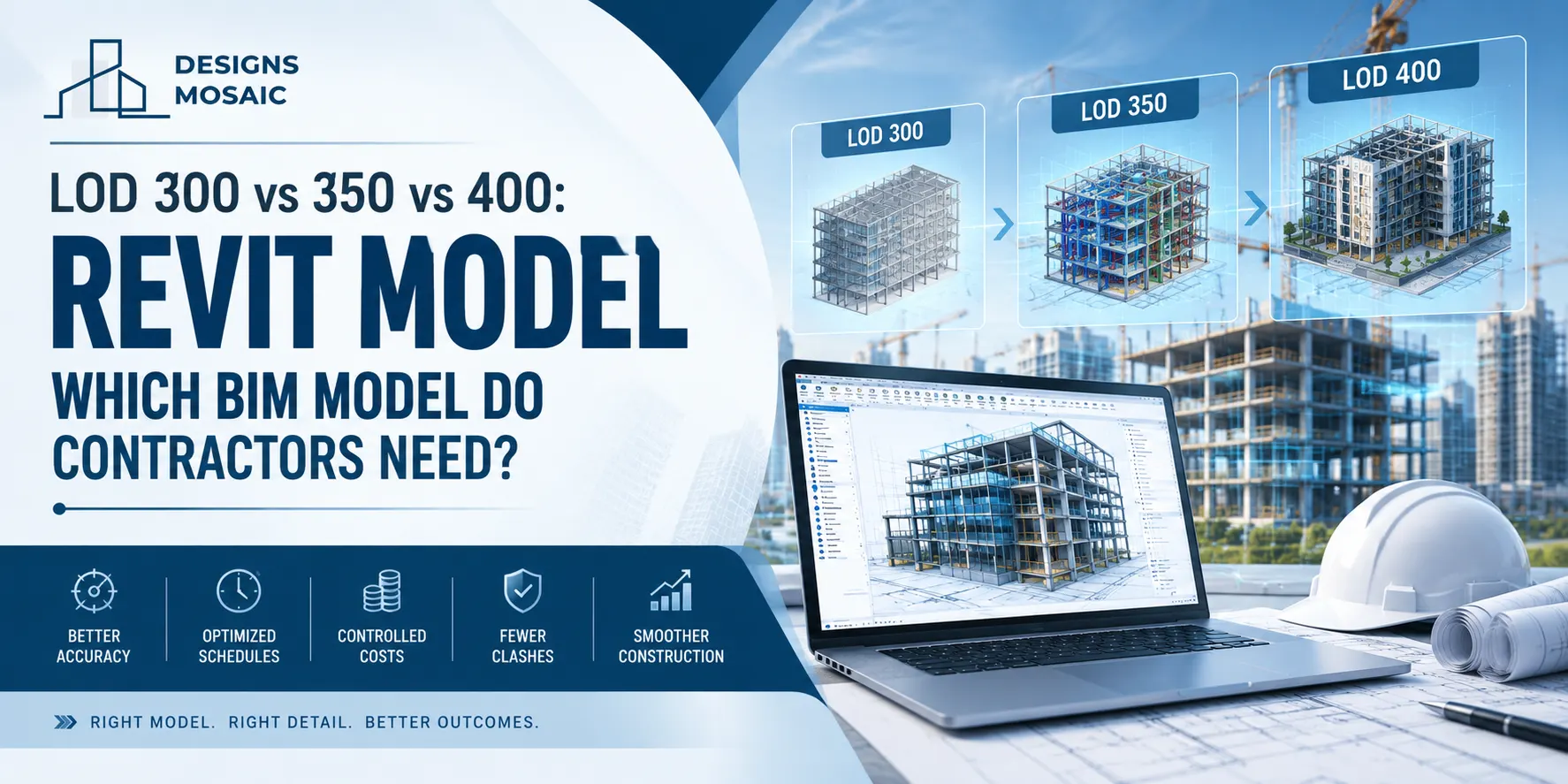
More detail does not automatically make a BIM model more useful. For contractors, the real question is whether the model contains the right information for the work being performed.
This is where Level of Development, or LOD, becomes important. When contractors engage BIM modeling services, they may encounter requirements for LOD 300, LOD 350 or LOD 400. Each serves a different purpose, and choosing a higher LOD than necessary can add modelling effort without creating equivalent project value.
Understanding the difference helps contractors request models that support actual project requirements.
First, What Does LOD Really Tell You?
LOD describes how developed and reliable model elements are at a particular project stage. It is not simply a measure of how realistic a model looks.
As the LOD increases, model elements generally contain more developed geometry and information for their intended use.
For contractors, this matters because BIM models can support different activities, including:
- Construction planning
- Multidisciplinary coordination
- Clash detection
- Drawing production
- Quantity-related workflows
- Fabrication and installation planning
The required LOD should therefore be linked to what the contractor intends to do with the model.
LOD 300: When Accurate Design Geometry Is the Priority
At LOD 300, model elements are represented with defined size, shape, quantity, location and orientation suitable for the intended design use.
This level can be appropriate when contractors need a dependable representation of the developed design but do not yet require detailed interfaces between building systems.
For example, architectural walls, structural members or MEP components may have sufficient geometry to understand their positions and dimensions.
LOD 300 can support several design and construction planning activities, but it has an important limitation. Knowing where an element is located does not necessarily show exactly how it interacts with neighbouring systems.
That becomes important when coordination moves closer to construction.
LOD 350: The Coordination-Focused Model
LOD 350 develops the model further by representing interfaces with other building systems.
For contractors managing multiple disciplines, this difference can be significant.
Consider an MEP system running through a structural zone. Knowing the approximate or defined location of the services is useful. However, coordination may also require understanding penetrations, supports, clearances or relationships with surrounding components.
This is where BIM coordination services become particularly relevant. The model is no longer being viewed discipline by discipline. Teams need to understand how different systems work together within the available space.
LOD 350 is therefore often useful for:
- Multidisciplinary coordination
- Identifying spatial conflicts
- Reviewing system interfaces
- Supporting clash detection
- Planning coordinated installation routes
- Resolving issues before site work progresses
For many contractor-led coordination workflows, LOD 350 can provide a practical balance between useful detail and unnecessary modelling.
LOD 400: When Fabrication Detail Becomes Necessary
LOD 400 goes further. Elements are developed with the detail needed for fabrication and assembly purposes.
That distinction matters.
A contractor should not request LOD 400 simply because it sounds more complete. Developing a fabrication-level model can require significantly more project-specific information.
LOD 400 becomes relevant when the model needs to support how components will actually be fabricated, assembled or installed. This may involve detailed connections, assemblies and other fabrication-specific information appropriate to the relevant system.
For contractors, the decision should come back to a simple question: will this information actually be used?
If the project only requires coordination, requesting fabrication-level development across the entire model may create unnecessary work.
One Project May Need More Than One LOD
A common mistake is treating LOD as a single setting for the complete BIM model.
Real projects are rarely that simple.
Different systems can require different levels of development at different stages. A contractor may need certain elements developed further for coordination or fabrication while other parts of the project remain adequately represented at LOD 300.
Good BIM modeling services should therefore begin with model purpose rather than automatically pushing every element towards maximum detail.
Before deciding, contractors should establish:
- Who will use the model?
- What decisions must it support?
- Which disciplines require coordination?
- Will fabrication information be required?
- What information must be reliable at each project stage?
Clear answers help prevent both under-modeling and unnecessary over-modeling.
Coordination Matters as Much as Model Detail
LOD alone cannot guarantee a coordinated project.
A highly detailed model can still contain clashes, inconsistent information or poorly resolved interfaces between disciplines. This is why BIM coordination services remain important even when models have been developed to a high LOD.
Coordination requires teams to review models together, identify conflicts and determine how those conflicts should be resolved.
In practical terms, contractors need both the appropriate model detail and a clear coordination process.
So, Which LOD Should a Contractor Choose?
There is no universal answer. LOD 300 can support developed design requirements, LOD 350 becomes valuable when system interfaces and coordination matter, and LOD 400 is appropriate when fabrication and assembly information is genuinely required.
The better approach is to define the intended model use first and select the necessary LOD from there.
Designs Mosaic provides BIM modeling services and BIM coordination services, including BIM modelling, clash detection and multidisciplinary coordination support. The team can support AEC projects with BIM deliverables aligned with defined project requirements.
FAQs
1. What is the main difference between LOD 300 and LOD 350?
LOD 300 represents elements with developed geometry and information, while LOD 350 also addresses how elements interface with other building systems, making it particularly useful for coordination.
2. Does every contractor need an LOD 400 BIM model?
No. LOD 400 is generally relevant when fabrication and assembly-level information is required. Contractors focused primarily on coordination may not need every model element developed to this level.
3. Is LOD 350 suitable for clash detection?
It can be particularly useful for coordination and clash-detection workflows because system interfaces are developed beyond the level typically represented at LOD 300.
4. Can different elements in the same BIM model have different LODs?
Yes. Model development can vary according to the intended use, discipline, project stage and information required from individual elements.
5. Is a higher LOD always better for construction?
No. More detail requires additional modelling effort and may provide little value if the information will not be used. The appropriate LOD should be determined by the model’s intended purpose.