
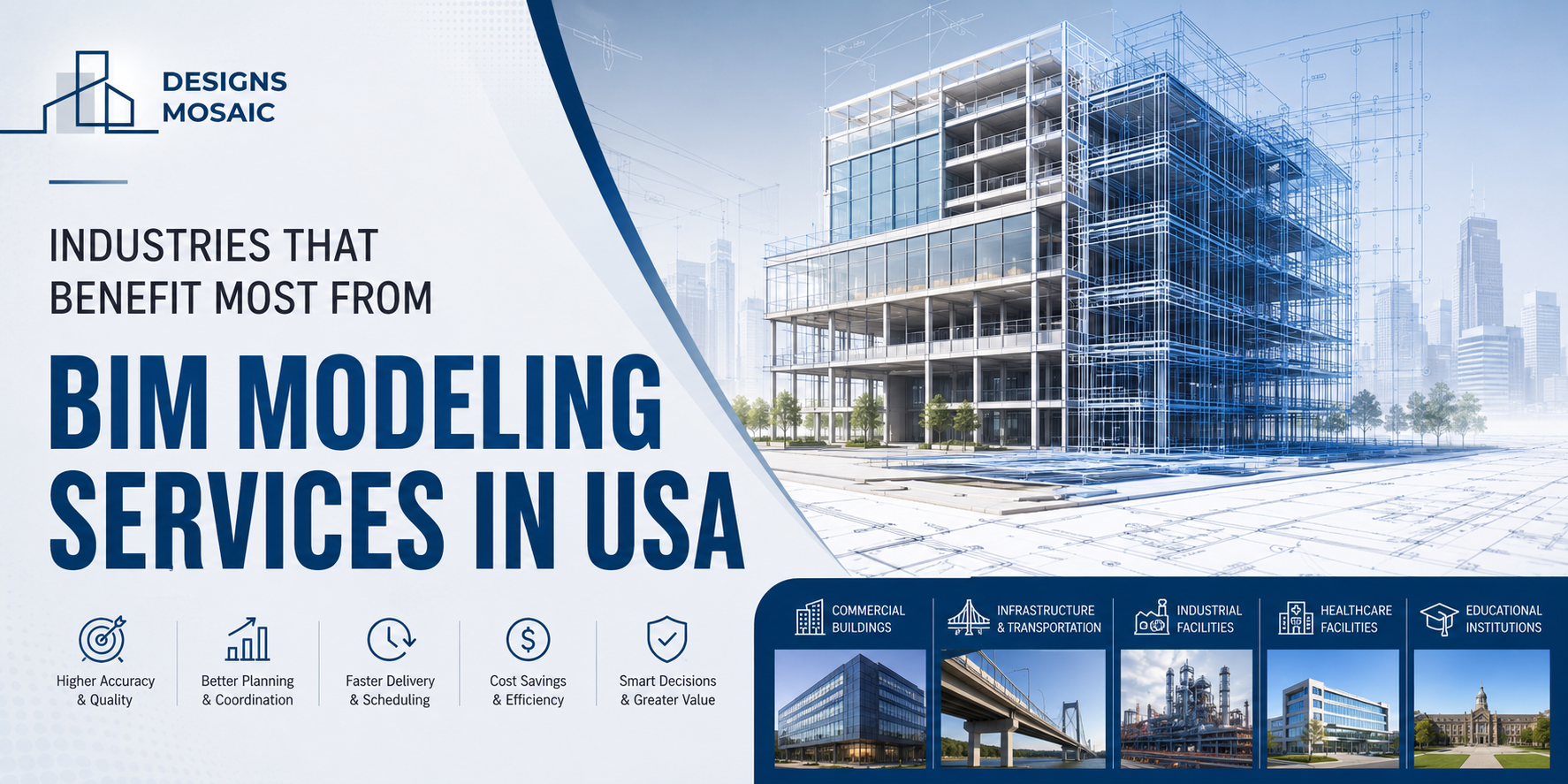
There has been a major transformation within the American construction and infrastructure industry in terms of how projects are conceived, developed, and carried out. With the advent of digital collaboration software tools, many project stakeholders have realized the importance of employing them in order to cut down on time losses, enhance efficiency, and simplify workflow processes. Among these technologies, BIM modeling services in the USA have become one of the most valuable solutions for architects, engineers, contractors, and developers.
Building Information Modeling (BIM) entails developing intelligent 3D models that consist of geometry information, engineering data, scheduling, costing, and management information in one interactive space. In this way, the project team can foresee conflicts, communicate efficiently, and make sound decisions much earlier than during the execution stage of the work.
Today, various sectors of the industry extensively use the BIM technology.
Commercial Construction and Real Estate Development
The use of BIM software in commercial building design is one of the largest applications in the United States. Office complexes, shopping malls, hotels, and hybrid structures comprise several parties involved concurrently. Manual coordination among architects, engineers, and MEP systems could create conflicts that would cause delays in projects.
BIM provides commercial developers with the following benefits:
- Effective communication between various departments
- Avoidance of clash detections before construction
- Accurate design documents for construction purposes
- Quick project approval processes
- Better budget and time management
Additionally, BIM enhances visualization for commercial real estate developers since investors and clients gain an understanding of the final output of the project through detailed walkthroughs and renderings.
Healthcare Infrastructure
A hospital or any other healthcare facility will need extensive detailing due to the complex nature of the building, as any mistake during the design phase can affect functionality and even patients’ lives. The building will have an HVAC system, electrical system, medical gas pipelines, and will comply with various healthcare standards.
Using BIM in healthcare allows for:
- Effective space utilization
- Optimised equipment placement
- Better maintenance planning of the facility
- Minimisation of disruption during renovations
- Compliance with healthcare regulations
The use of digital twins and facility management integration also helps with the management of the building during operations for easier maintenance and further improvements.
Industrial and Manufacturing Facilities
Industrial plants and manufacturing units are known to be among the most challenging constructions technologically. This is because the plants include heavy machinery, utilities, piping, and assembly lines.
The use of BIM workflow allows manufacturers to:
- Visualize the layout of the plant before installing it
- Ensure enhanced safety
- Reduce costs associated with reworks
- Coordinate complex mechanical systems
- Achieve higher operational efficiency
It becomes particularly relevant in industries such as automotive manufacturing, the food industry, pharmaceuticals, and energy generation because downtime can cost the companies dearly.
Residential and Multi-Family Housing
The residential segment has also begun to embrace BIM technology more extensively. Apartment complexes, walled residential colonies, and luxury homes need effective planning and better resource management.
Some of the applications of BIM in construction for the residential segment include:
- Quantity take-offs with accuracy
- Better material management
- Faster construction timelines
- Effective coordination with contractors
- Designing energy-efficient buildings
Sustainability and smarter homes are becoming a priority among contemporary buyers. BIM can help achieve the objective through energy analysis, light and shade simulation, and effective space utilization during design.
In large residential projects, the use of BIM modeling services in the USA is proving beneficial for maintaining uniformity across units as well as ensuring project success.
Transportation and Infrastructure Projects
Development of infrastructures within the United States is still on the rise, with developments such as the construction of roads, bridges, airports, rail transport, and even mass transportation being carried out. Such developments have many stakeholders involved in the development process.
Use of BIM helps improve infrastructure planning through:
- Creation of accurate terrains models
- Facilitation of easy utility coordination
- Making project scheduling easy
- Minimizing construction risk
- Better management of lifecycle assets
BIM technology is applied by transportation officials to plan for future maintenance needs. The use of digital models helps in assessing future needs.
The application of BIM technology is greatly useful in airports and railway stations since they require complex architectural design, high traffic levels, and high safety standards.
Education Sector and Institutional Buildings
Learning establishments and other research-based institutions need spaces that are flexible enough to change according to future needs. This is where BIM comes in; BIM makes sure that the establishment creates sustainable and adaptable facilities.
Some advantages of BIM in the education industry are:
- More efficient campus design
- Proper classroom and laboratory design
- Better energy efficiency
- Facilitated renovation
- Facility management optimization
For universities, BIM can be useful for campus asset management, which enables maintenance personnel to manage their campus assets more efficiently.
Hospitality and Entertainment Spaces
Hotels, resorts, conference centers, and entertainment facilities require aesthetics and user experience above everything else. BIM helps engineers and architects make the best of both worlds: design and performance.
Thanks to BIM, hotels and resorts will get an opportunity to have:
- Improved space management
- More effective coordination in luxury interior design
- Quick revisions and corrections
- Better lighting and acoustic management
- Minimal delays during construction
When it comes to entertainment facilities such as stadiums and theaters, BIM helps cope with big-scale planning and logistics easily.
Energy and Utility Sector
The construction of infrastructure involving power generation plants, renewable energy sources, sub-stations, and utilities involves a lot of engineering coordination. The use of BIM increases precision in planning and reduces operational risks during these vital constructions.
BIM has many applications in the energy industry, such as:
- Structural and mechanical coordination
- Management of asset lifecycles
- Planning of renewable energy projects
- Risk and safety assessment
- Optimization of maintenance
As more renewable energy installations grow throughout America, the value of BIM will be seen more often as it is used for the construction of solar power farms, wind energy plants, and sustainable infrastructure development.
Government and Public Sector Projects
The government is using BIM for construction projects to make them transparent, efficient, and more affordable. There are many instances where federal and state government departments use BIM for major infrastructure developments.
These include:
- Increased project accountability
- Improved coordination between departments
- Effective budgeting and forecasting
- Minimized construction disputes
- Efficient lifecycle management of buildings
BIM also helps in implementing initiatives related to smart cities by bringing together urban planning, utility, and transport infrastructure in one unified digital setting.
The Expanding Role of BIM Across Modern Industries
With increasing technological complexity and the sustainability of construction projects, the use of BIM is not restricted solely to big construction ventures. In today’s world, companies operating in several industries have realized the significance of data-based construction and collaboration.
With regard to the growing demand for BIM modeling services in the USA, it is due to the fact that there is a need for high accuracy, high speed, and effective operations in the industry. BIM is changing the face of industries in terms of healthcare and residential construction, industrial construction, and infrastructure development.
When companies seek BIM services from credible companies, one of the key considerations is knowledge in the area of coordination between different fields, 3D modeling capabilities, clash detection, and construction documentation services. Companies such as Designs Mosaic have been identified to support modern construction operations with their BIM services in the areas of architectural BIM services, MEP BIM services, structural drafting, CAD conversions, and virtual design coordination. Alongside growing demand for 3D BIM modeling services, MEP coordination services, construction documentation services, clash detection and coordination, and architectural drafting services, BIM continues to shape the future of the built environment in the United States.