
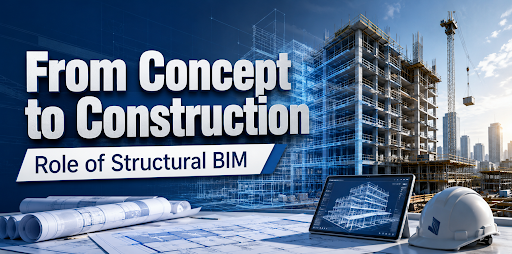
The construction industry has evolved from basic drawings and manual calculations. Currently, digital collaboration and intelligent modeling are the foundations of architecture when it comes to designing structures. One of the most revolutionary ways in which buildings are designed currently is using Structural Building Information Modeling (BIM). By making use of intelligent modeling and data management, structural BIM architectural modeling services help bring a seamless transition between the concept design and building processes.
Understanding Structural BIM in Modern Construction
Structural Building Information Modeling (BIM) goes beyond the idea of 3D modeling itself. It includes integrating design, analysis, and documentation in an electronic form that allows the whole structure to be visualized before constructing it physically.
Unlike traditional methods, Structural BIM guarantees the coordination of all parts of the building, including beams, columns, slabs, and foundations, among others. Any changes made to one element automatically affect the entire model without causing any discrepancy.
This makes the whole process of planning and designing buildings much easier since the process ensures coordination among different departments involved in the process.
Bridging the Gap Between Design and Execution
One of the greatest problems in construction is the disconnection between the concept of design and actual implementation on site. Structural Building Information Modeling solves this problem by creating a common platform where everyone involved can collaborate in real-time.
This is how this solution makes a difference:
- Improved Visualization: Models give people the ability to clearly visualize even the most complex shapes.
- Conflict Identification: Detects conflicts among the building structure, architecture, and mechanical aspects before actual construction.
- Accurate Documentation: Generates precise drawings and schedules from the models.
- Enhanced Coordination: Enables efficient coordination among architects, engineers, and contractors.
Thus, through Structural BIM, you can foresee many issues in advance and save yourself from potential errors.
Enhancing Precision and Reducing Errors
Precision is extremely important when creating structural designs. Any small mistake made can result in large issues during construction. In this way, Structural BIM helps solve this problem since one can simulate almost everything before starting construction.
The engineer can see how the structure behaves under different conditions and whether its design will be sufficient. This simulation greatly reduces the risk of errors and ensures that the structure is optimal regarding cost-efficiency and performance.
Moreover, automatic updates will rule out any possibility of having to go for repeated manual revisions, which may result in human errors.
Data-Driven Decision Making in Structural BIM
The benefits of visualization and coordination of Structural BIM go hand in hand with data-driven analysis, which allows for better decision-making through every stage of the process. Each object within a BIM model includes vast amounts of information ranging from technical data to performance parameters, allowing the stakeholders to make an accurate assessment of multiple design alternatives.
Through analyzing large volumes of structured information, stakeholders are able to make rational decisions about selecting certain designs, thereby ensuring efficiency of the design process and decreasing the number of potential errors. Structural BIM makes it possible to analyze and compare various structural systems and determine their efficiency regarding costs and performance.
Driving Efficiency Across Project Phases
Structural BIM makes processes more efficient from beginning to end, starting from planning until the construction of the project. Teams can optimize their operations, utilize resources in an efficient manner, and keep track of time schedules well throughout the process.
In between this process, the role of BIM architectural modeling services becomes very important for the integration of structure in line with the architecture of the project.
Some main efficiencies that Structural BIM brings about are:
- Rapid iterations and approvals for designs
- Reduction in wastage of materials by accurate quantity estimation
- Scheduling made easier with 4D BIM (time-based model)
- Effective cost management through 5D BIM (cost-based model)
The above-discussed benefits clearly demonstrate why Structural BIM has become an essential part of the construction process in contemporary times.
Supporting Sustainable and Smart Building Practices
There has been a shift towards sustainability in recent years. Structural BIM helps achieve that goal through improved planning and resource utilization.
The model enables teams to:
- Choose sustainable building materials
- Enhance energy efficiency
- Cut down waste generated during the construction phase
- Contribute to reducing the carbon footprint
It is important to note that BIM does not just play a role during the construction stage but also after the completion of a project, where building owners can manage facilities.
Real-Time Collaboration and Transparency
Transparency is another advantage provided by Structural BIM. Cloud computing allows for instant information sharing among all stakeholders.
Real-time collaboration guarantees the following advantages:
- Improved decision-making process
- Increased accountability of teams
- Decreased probability of misunderstandings
- Efficient monitoring and reporting of projects
Transparency helps to foster cooperation between parties and facilitates project management.
Adapting to Complex and Large-Scale Projects
As construction projects become more complicated, the necessity of applying modeling solutions increases. Structural BIM proves to be helpful, especially in cases of large-scale projects that require coordination of numerous systems.
Regardless of whether the object is an apartment building, infrastructure facility, or industrial enterprise, BIM offers an opportunity to cope with complexity. With its assistance, professionals can plan, coordinate, and carry out any projects successfully.
A Smarter Way Forward for the AEC Industry
Innovation is increasingly embraced by the Architecture, Engineering, and Construction (AEC) industry, but Structural BIM plays the pioneering role within this field. The use of innovative solutions will definitely provide benefits for professionals since they simplify the job and make it more efficient.
Designing, analyzing, and construction have become inseparable due to BIM technology that transforms the process of project development. However, in addition to being a method of designing and constructing, BIM can be regarded as an approach to better and faster construction.
Building the Future with Confidence
With the ongoing evolution of the industry, there is no doubt that innovation must play an integral role, and one way to achieve this is through the adoption of Structural BIM. There is no denying the many benefits of Structural BIM, from greater accuracy to better collaboration. Collaboration with reputable firms that provide BIM architectural modeling services may just lead to success.
If you are looking to maximize the potential of BIM, Designs Mosaic would be the ideal choice for your business. With their extensive expertise and future-oriented mindset, they can efficiently execute even the most complex designs. They utilize advanced technologies coupled with industry expertise to deliver projects effortlessly.