
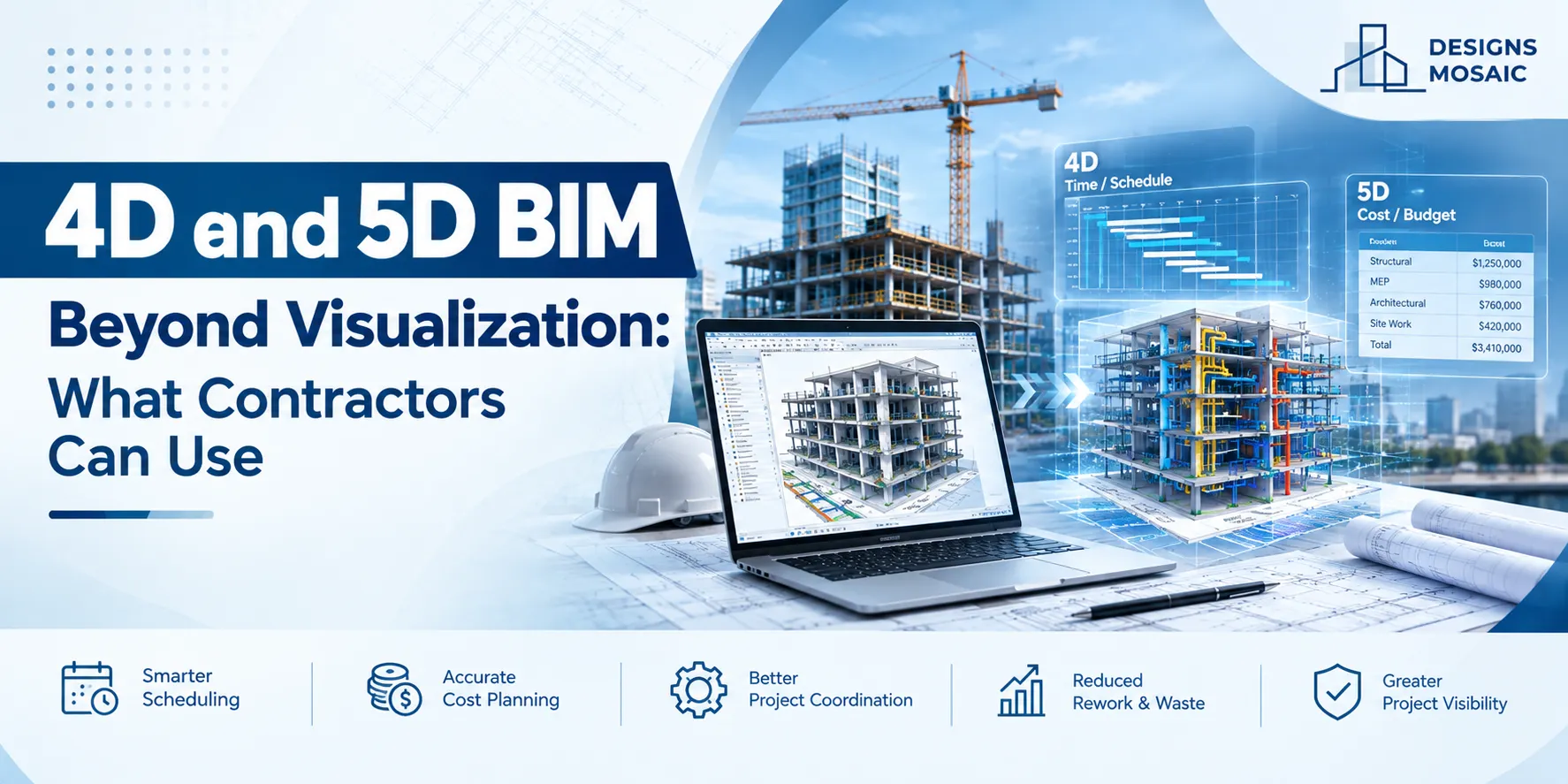
A 3D model shows what a project is intended to become. Add the construction programme, and teams can begin examining when different parts will be built. Connect relevant cost information, and the model can support another layer of project understanding.
This is the basic idea behind 4D and 5D BIM. Yet their value is sometimes reduced to impressive animations for meetings. For contractors, the more important question is how these workflows can support real project decisions. This is also where BIM consulting services can help teams define what information should be connected and why.
4D BIM Makes the Programme Spatial
A conventional construction schedule contains activities, dates, durations and dependencies. It tells the team when work should happen, but understanding how those activities interact physically can require experience and interpretation.
4D BIM connects model elements with scheduling information.
Instead of reading the programme only as rows of activities, teams can review how the planned construction sequence develops within the actual project environment.
That makes 4D useful for more than presentation.
Contractors Can Test Construction Sequences
Imagine several trades needing access to the same area during a limited period. Their activities may appear reasonable in a schedule while creating practical difficulties when considered spatially.
A 4D workflow can help teams examine:
- Which areas are planned for construction first
- How different work packages overlap
- Whether planned sequencing makes spatial sense
- When particular building elements are expected to be installed
- How construction progresses through different zones
- Whether programme changes affect surrounding activities
The objective is not to create the smoothest animation. It is to make the programme easier to understand in the context of the building.
4D Can Improve Planning Conversations
Construction planning involves people with very different roles.
A scheduler may understand programme logic immediately, while a site supervisor or project stakeholder may find it easier to understand the same sequence when it is connected to the model.
This gives contractors a common visual reference during planning discussions.
When the programme changes, the model can also help teams communicate what the change means physically. A delayed activity is no longer just a shifted bar on a schedule. Teams can see which part of the project it relates to and consider the wider sequencing implications.
For BIM consulting services, the important task is ensuring that model information and project planning requirements are structured appropriately before expecting useful 4D outputs.
5D BIM Adds Cost to the Picture
5D BIM introduces cost-related information into the model-based workflow.
This does not mean a BIM model automatically becomes a complete estimating system. The usefulness of 5D depends heavily on how model elements, quantities, classifications and cost information are structured.
When those foundations are reliable, contractors can use model information to support quantity and cost-related workflows.
For example, teams may be able to examine how design or quantity changes affect relevant cost information rather than treating the model and estimate as completely separate sources.
Where 5D Becomes Useful During Change
Change is where the value becomes easier to see.
Suppose a design revision changes quantities across part of the building. In a disconnected workflow, teams may need to identify the revised elements, calculate updated quantities and then determine what those changes mean commercially.
A structured 5D approach can create a clearer connection between the physical model and related project quantities or costs.
Potential uses include:
- Supporting quantity take-offs
- Reviewing cost implications of design changes
- Comparing selected project alternatives
- Connecting model development with estimating workflows
- Tracking how revised quantities affect relevant cost information
However, the model is only as useful as the information inside it. Incorrect classifications or inconsistent model elements can produce unreliable outputs faster.
More Dimensions Do Not Fix Poor BIM
This is the part contractors should not overlook.
A project does not gain useful 4D or 5D capability simply by adding schedule or cost data to a 3D model.
The underlying information needs to be suitable for the intended workflow.
Before implementation, teams should establish what the model needs to support, how elements will connect with activities or cost information, who maintains those connections and how revisions will be controlled.
This is where BIM consulting services can have practical value. The priority should be designing an information workflow around project decisions, not introducing additional BIM dimensions because the technology is available.
Contractors Should Start With a Problem
The most effective starting point is not, “We want 5D BIM.”
It is a specific project question.
Do teams struggle to understand sequencing? Is communicating programme changes difficult? Does quantity information take too long to update after revisions? Are model and estimating workflows disconnected?
Once the problem is clear, contractors can decide whether 4D or 5D BIM offers a useful way to address it.
BIM Becomes Valuable When It Supports Decisions
4D and 5D BIM are moving beyond visualisation because contractors can use model information to understand time, sequencing, quantities and cost relationships more clearly. Their value depends on disciplined modelling and clearly defined project uses.
Designs Mosaic provides BIM consulting services alongside BIM modelling, coordination and related digital project support. Its BIM capabilities can support AEC teams in developing workflows around defined project and information requirements.
FAQs
1. What is the difference between 4D and 5D BIM?
4D BIM connects model information with the construction schedule or time dimension. 5D BIM adds cost-related information to support quantity and commercial workflows.
2. Is 4D BIM only useful for construction animations?
No. Contractors can use 4D workflows to review construction sequences, understand spatial relationships between scheduled activities and communicate programme changes more clearly.
3. Can 5D BIM automatically calculate construction costs?
Not automatically in every workflow. Reliable outputs depend on appropriately structured model elements, quantities, classifications and cost information.
4. When should contractors consider using 4D BIM?
It can be useful when sequencing, work-package interaction, programme communication or understanding the spatial impact of schedule changes is important.
5. Do contractors need highly detailed BIM models for 4D and 5D?
Not necessarily. Model development should match the intended use. Unnecessary detail can increase effort without improving planning or cost-related decisions.